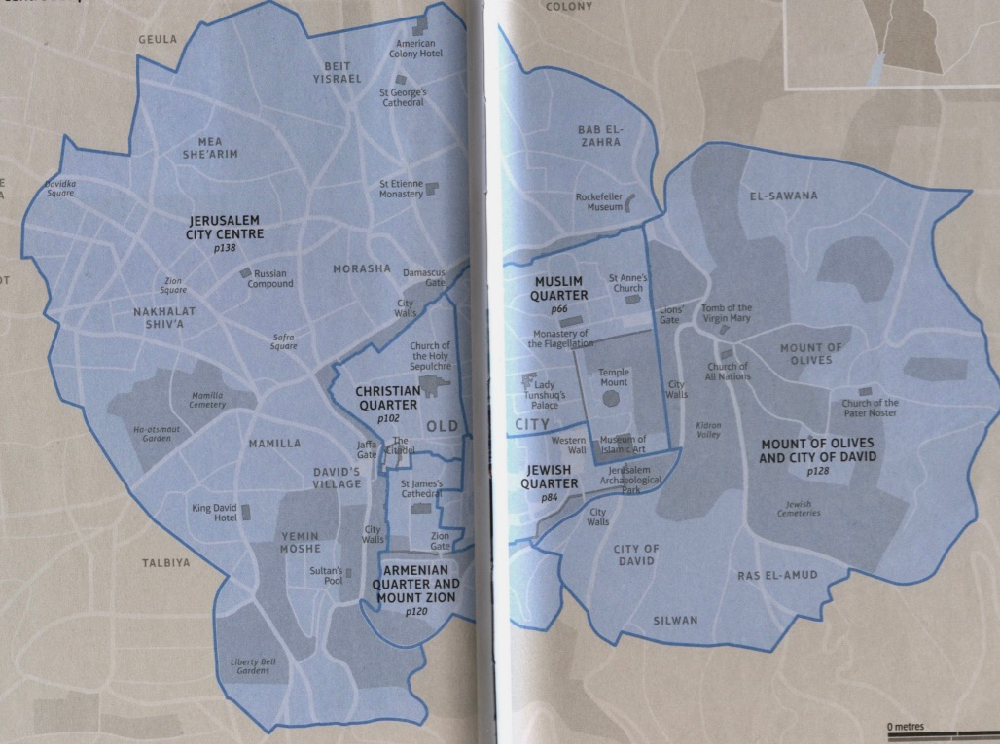
Jerusalem is, of course, a sacred site for the world's three major monothestic religions: Christianity, Islam, and Judaism. The Old City is divided into four quarters: Armenian, Christian, Jewish, and Muslim. These represent a 19th-century cartographic partition, into four quarters, that represented the historical development of a city that had previously been divided into many more areas and neighborhoods. The Armenian, Christian, and Jewish Quarters are open to all. The Muslim Quarter is restricted to only those of the Islamic faith. The maps below show the City and Old City of Jerusalem and each of the Quarters with important places noted. Red Roman numerals on the various maps indicate the locations of the Stations of the Cross.
Today we spent the day in the Old City of Jerusalem. It is a quite compact area where just about everywhere you turn there is a major historical structure or place where an important event occured. It was really overwhelming!
City of Jerusalem: Old City is in the Center
Jewish Quarter
Christian Quarter
Muslim Quarter
Armenian Quarter
Our first entry into the Old City was through the Dung gate into the Jewish Quarter. From the gate we went directly to the Western Wall of the Second Temple. People come to pray there so their prayers enter the Rock and then go up to heaven. Men and women are separated at the wall - men on the left and women at a smaller section on the right.
Damascus gate
Archeological Park - Dome and minaret of al-Aqsa Mosque
Dome of al-Aqsa Mosque
Minaret of al-Aqsa Mosque complex
Western Wall - women's side
Western Wall - men's side
Western Wall with examples of the slips of paper containing wishes or prayers left there by faithful.
We took the tour through the Western Wall's underground tunnels. This underground ancient city of Jerusalem is a remnant of the Second Temple period and we could see and touch the massive stones that were used 2,000 years ago to build the the Western Wall which was a retaining wall of the Temple Mount. The Western Wall is also known as the Wailing Wall. There is a synagogue under the city next to these walls. The synagogue has a globe shaped Ark of the Covenant and a large menorah.
Entrance to the Western Wall tunnels
From a movie depicting the destruction of the Second Temple
Western Wall tunnels site
Western Wall tunnels site - stonework
Western Wall tunnels site
Synagogue within the Western Wall tunnels
Round Ark of the Covenant made of sculpted metal in the Synagogue within the Western Wall tunnels site
Western Wall tunnels site - Women's section
Western Wall tunnels site - Women's section
Mughrabi Bridge - Connects Western Wall Plaza to Temple Mount
After the Western Wall tunnels visit, the group walked through the Arab Souq area of the Muslim Quarter. Along the Cottom Merchant's street we saw many small shops selling a large variety of goods.
Sign for a Hammam
Entrance to Cotton Merchant's street - in the Arab Souq
Along Cotton Merchant's street
Along Cotton Merchant's street
From doorway at the end of the Cotton Merchant's street, we could see part of the the gold dome (the Dome of the Rock) of the mosque that is the third holiest site after the mosques in Mecca and Medina. This is the place where Mohamed is believed to have ascended into heaven. The doorway was carefully guarded by Muslim guards who made sure we did not get beyond the door's frame.
Cotton Merchant's street - in the Arab Souq
Candy shop - Cotton Merchant's street
Candy shop - Cotton Merchant's street
Door Along Cotton Merchant's street
Coffee stand
Local police presence - in the Arab Souq
Street sign - in the Arab Souq
Street scene - in the Arab Souq
Street scene - in the Arab Souq
In the Arab Souq
Ever-present, heavily armed Israeli soldiers
In the Arab Souq
Ornate manhole cover
Street scene - in the Arab Souq


| Return to Top | Return to Itinerary | Return to Trips page to view other trips | Return to Dreamcatcher Home Page |